

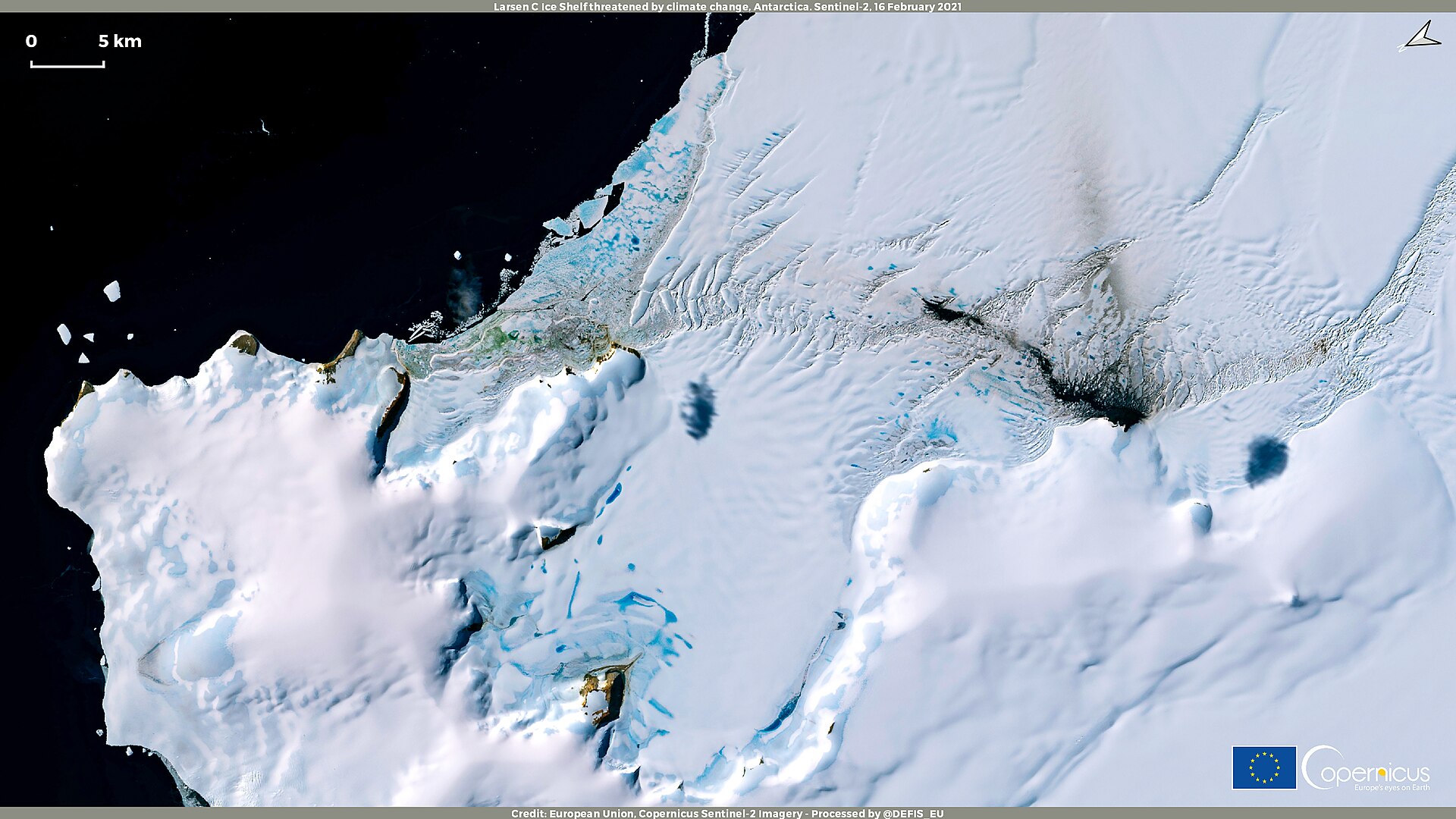
Every coastal city on Earth has a stake in a question being studied at the bottom of the world: how fast will Antarctica lose its ice? The continent holds enough frozen water to raise global seas by many metres over the long term, and even a fraction of that loss this century would redraw flood maps, insurance markets and defence planning for low-lying communities from Miami to Dhaka.
The difficulty is that Antarctica is not melting like an ice cube in the sun. Its great ice sheet flows outward in glaciers, buttressed by floating ice shelves that slow the ice behind them. Warm ocean water thinning those shelves from below can release the brakes on the glaciers they restrain, which is why oceanographers and glaciologists now work as one discipline, watching water and ice together.
Measuring a Continent That Fights Back
The observational effort is immense and ingenious. Satellites weigh the ice sheet through tiny changes in gravity, measure its surface height to centimetres, and track glacier speeds year by year. On the ground and under the ice, autonomous floats, drilled boreholes, radar surveys and instruments moored in dark ocean cavities gather the data that satellites cannot, in weather that destroys equipment as a matter of routine.
Institutions such as the British Antarctic Survey and the missions coordinated by NASA feed those measurements into models of the ice sheet’s future. Coverage at our news coverage follows the results, which have converged on an uncomfortable finding: parts of West Antarctica are losing ice faster than they did a generation ago, and some glaciers may have passed thresholds beyond which their retreat continues even without further warming.
Why the Range of Futures Is So Wide
Sea-level projections for 2100 still span a wide range, and Antarctica accounts for most of the spread. The uncertainty is not mainly about whether ice will be lost, but about processes that are genuinely hard to model: how ice cliffs fracture, how meltwater lubricates glacier beds, and how ocean currents will deliver warm water beneath shelves as winds and seas change around the continent.
That uncertainty cuts both ways politically. The lower end of the range means serious but manageable coastal adaptation; the upper end means defences and land use being overwhelmed in many places within the lifetime of infrastructure now being built. Planners increasingly work with the high-end scenarios for long-lived assets like ports, power stations and new housing, on the reasoning that under-preparing is the costlier error.
Watching the Ice Is the Cheapest Defence
Against the scale of what is at stake, Antarctic science is inexpensive. The monitoring systems that will give coastal cities the earliest possible warning of accelerating loss cost a small fraction of a single major flood barrier, yet their funding is often short-term and contested, and the logistics of polar research grow harder as the climate that researchers study disrupts seasons and sea ice.
The ice sheet will deliver its answer regardless of whether anyone is watching. Satellites and field teams in Antarctica are, in effect, reading the first draft of every coastline’s future, and the value of that reading rises with every year the world spends deciding how much of the coast it intends to defend, adapt or surrender.
The Wider Picture
There is also a human story inside the measurements. The scientists and support crews who winter in Antarctica, maintain instruments through months of darkness and return to the same glaciers year after year are building records whose value depends on continuity: a missed season is a permanent gap in the evidence. Several of the longest-running observation programmes are older than the researchers now extending them, handed over between generations like the ice cores they study. That continuity is fragile in a practical sense, dependent on ships, aircraft, fuel and budgets negotiated annually in distant capitals. Protecting it is among the cheapest forms of climate adaptation available anywhere, because every coastal decision made in the coming decades, from a sea wall to a housing estate, will be made in the light, or the absence, of what those instruments record.
More stories in this area are collected in our Global News section.
