

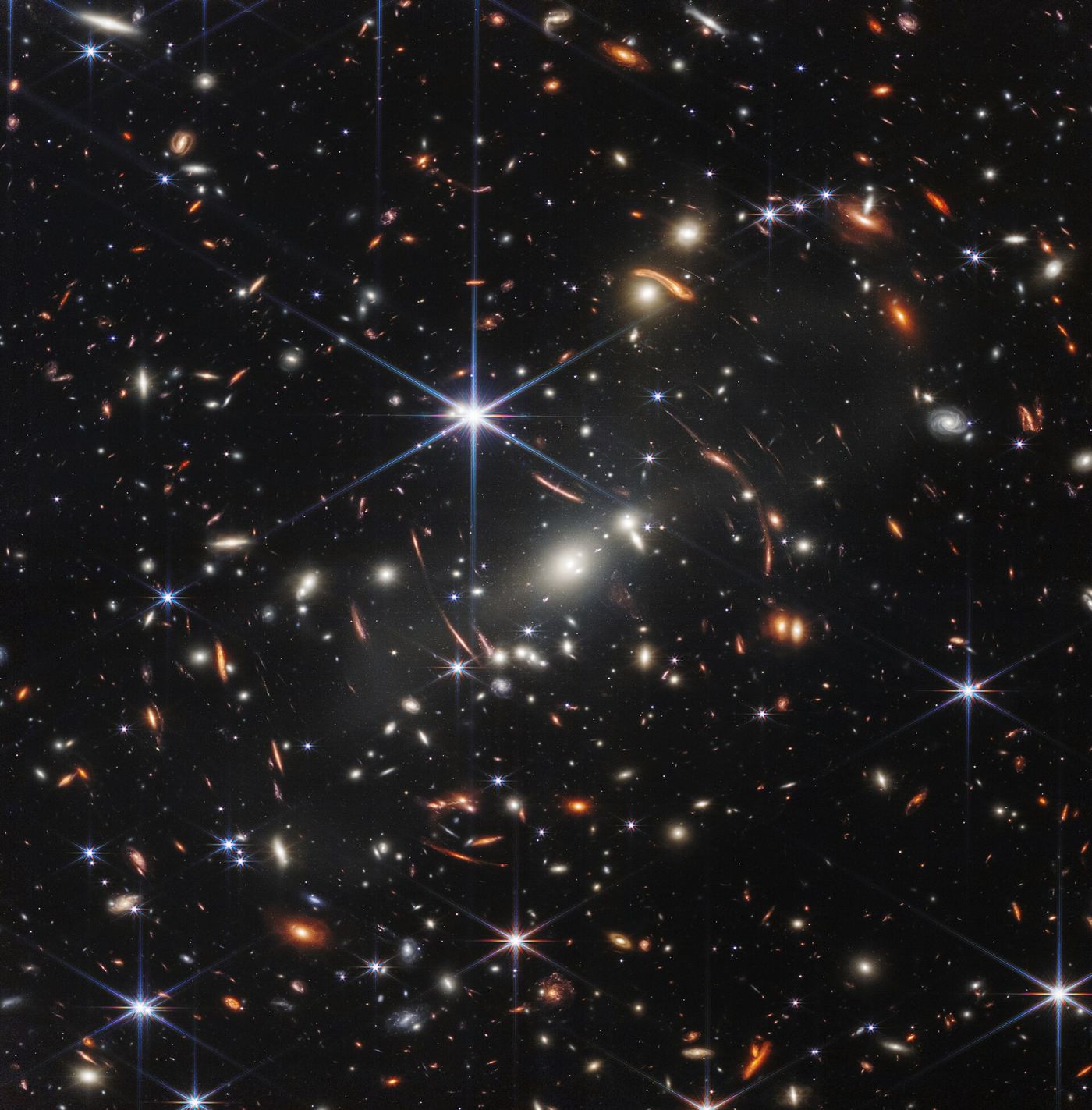
The James Webb Space Telescope has found the most distant galaxy ever confirmed, a faint smudge of light that shone less than 300 million years after the Big Bang. The galaxy, named JADES-GS-z14-0, was announced in May 2024 by an international team led by Stefano Carniani, and its light has been travelling for about 13.5 billion years to reach us. Its redshift, measured at 14.32, means the Universe has expanded so much since its light left that the wavelengths have stretched by more than fourteen times. What surprised astronomers is not only the distance but the brightness: the galaxy is unexpectedly luminous for such an early time, and it appears to be already rich in oxygen, an element that can only be made inside stars. That suggests stars were forming and dying in large numbers far earlier than models predicted.
What the Evidence Shows
The discovery is part of a pattern that has unsettled cosmology since Webb began observing in 2022. Again and again, the telescope has found galaxies that are too big, too bright and too mature for their age, more than ten times as numerous as pre-Webb models expected. The galaxy’s light was first spotted in Webb’s JADES survey, one of the deepest looks ever taken at the early Universe, and its distance was confirmed by splitting its light into a spectrum with the NIRSpec instrument. Some theorists have proposed that early galaxies formed stars far more efficiently, or that black holes contributed extra light, while others argue that the models simply underestimated how quickly gas could collapse into stars. JADES-GS-z14-0 is too far away for detailed study of its shape, but Webb’s follow-up observations with its mid-infrared instrument are already revealing more about its stars. Each new record pushes the frontier of the observable Universe a little further back, toward the first generation of stars. Reporting and analysis from sources such as National Science Foundation track the same developments, and specialists following most distant galaxy JADES-GS-z14-0 say the direction is now consistent across independent lines of evidence.
The Wider Context
The wider context is a research landscape in which replication and open data now decide reputations. Findings connected to most distant galaxy JADES-GS-z14-0 are being checked by independent groups with shared datasets, and the teams involved publish their methods in full so rivals can test every step. That discipline is slower than a headline cycle, but it is why results in this area increasingly survive first contact with scrutiny.
What Happens Next
What happens next in the story of most distant galaxy JADES-GS-z14-0 will be decided by follow-up work already under way: larger samples, longer observation and instruments that have not yet come online. The researchers involved are unusually united on one point, that the current results justify the next investment of time and money. Readers will not have to wait long for the first tests of that claim. You can follow related developments in our coverage of science.
There is a practical lesson in all of this for readers deciding what to do today. Start with the verified facts, be wary of anyone promising certainty, and prefer reversible steps while the evidence is still developing. Circumstances differ by country, income and personal situation, so general guidance should always be weighed against your own context before you act on it in any significant or lasting way.
